
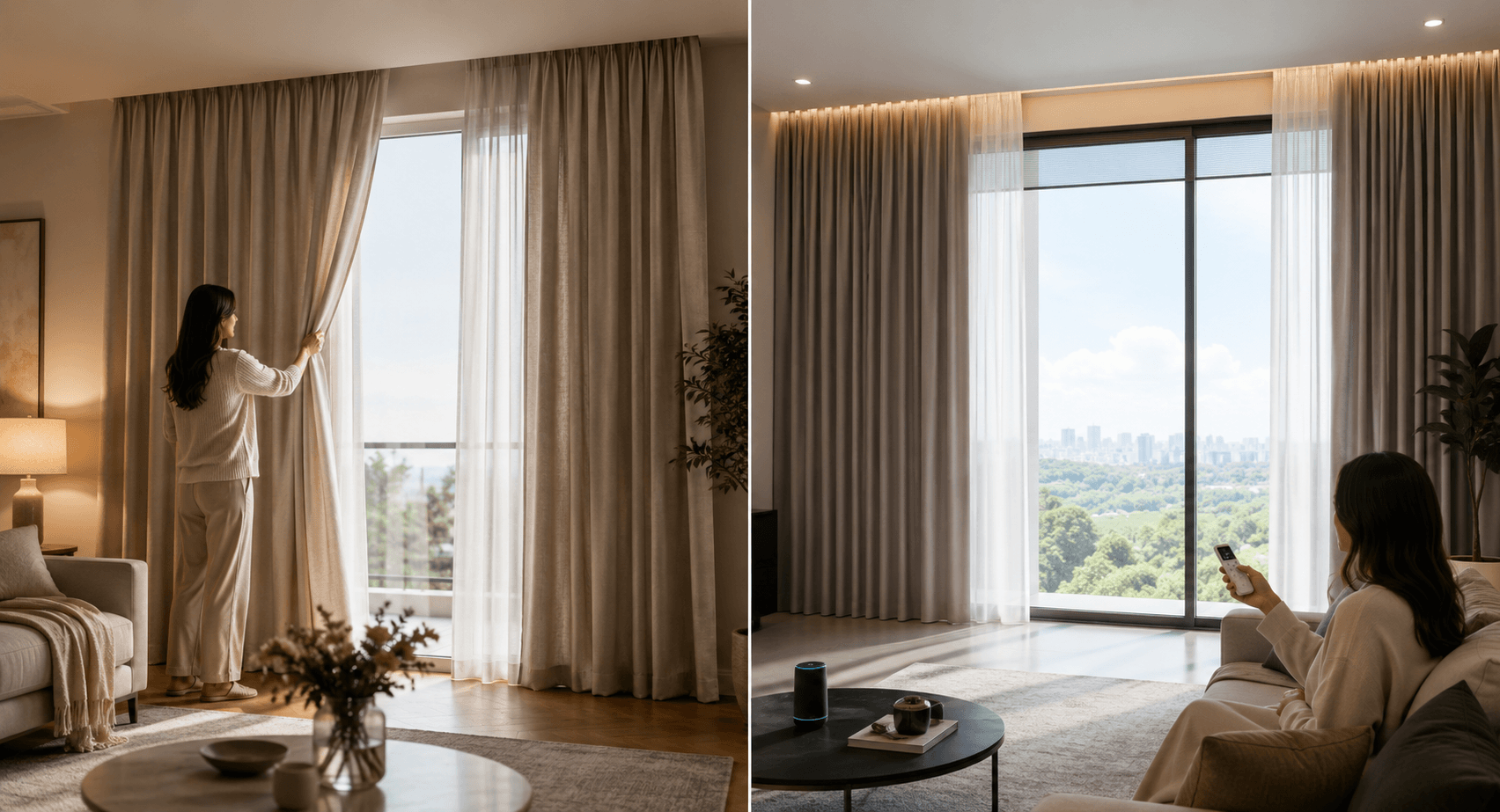
Choosing the right window treatments goes beyond selecting fabric and color, especially when deciding between manual vs motorized curtains for your home or office. This choice directly impacts daily comfort, privacy control, interior aesthetics, and overall convenience in how you interact with your space. While manual curtains offer simplicity and affordability, motorized curtains bring automation, smart control, and a premium lifestyle experience that fits modern interiors. Understanding how each system works and where it performs best helps you invest in a solution that aligns with your lifestyle, window size, and design expectations.
What Are Manual Curtains?
Manual curtains are traditional window coverings operated by hand using rods, cords, or simple pull systems, making them a practical and widely used option for residential and commercial spaces. They are known for their straightforward functionality, lower installation cost, and ease of maintenance, which makes them ideal for smaller rooms or windows that are not frequently adjusted. Manual curtains also allow complete freedom in fabric choice and design without requiring technical components, making them a flexible solution for classic and modern interiors alike.
What Are Motorized Curtains?
Motorized curtains are advanced window treatment systems that operate using an electric motor controlled by remote, wall switch, smartphone app, or smart home automation systems. They are designed for convenience, precision, and seamless movement, especially in spaces with large, tall, or hard-to-reach windows where manual operation becomes inconvenient. These smart curtain systems are increasingly popular in modern homes, offices, and luxury apartments because they combine technology with interior design, offering smooth operation, scheduled control, and enhanced lifestyle comfort.
Key Differences Between Manual and Motorized Curtains
The core difference between manual and motorized curtains lies in their operation, convenience level, and long-term usability, which significantly affects user experience in daily life. While manual curtains rely entirely on physical handling, motorized systems automate movement for effortless control and consistency. The table below highlights the most important differences to help you compare both options clearly and make an informed decision based on functionality, cost, and lifestyle needs.
| Feature | Manual Curtains | Motorized Curtains |
|---|---|---|
| Operation | Hand-pulled or rod-based | Remote, app, or smart control |
| Convenience | Basic, requires effort | High, fully automated |
| Cost | Lower upfront cost | Higher initial investment |
| Maintenance | Simple and low cost | Requires motor care |
| Ideal Use | Small to medium windows | Large, tall, or smart homes |
| Smart Integration | Not available | Fully supported |
When Manual Curtains Are the Best Choice
Manual curtains are the ideal choice for spaces where simplicity, budget efficiency, and occasional use are the main priorities rather than advanced automation or smart functionality. They work particularly well in guest rooms, small apartments, rental properties, and secondary spaces where curtains are not frequently adjusted throughout the day. For homeowners who prefer a traditional setup without relying on electrical systems or apps, manual curtains provide a dependable and straightforward solution that still allows for elegant fabric design and customized styling.
When Motorized Curtains Are the Best Choice
Motorized curtains are best suited for modern interiors where convenience, luxury, and daily functionality play an important role in how the space is used and experienced. They are especially effective in large living rooms, master bedrooms, office meeting spaces, and villas with floor-to-ceiling windows where manual operation can be inconvenient or impractical. If your lifestyle includes smart home systems, frequent light adjustments, or hard-to-reach windows, motorized curtains offer a seamless and time-saving solution that enhances both comfort and usability.
Convenience and Smart Home Integration
One of the biggest advantages of motorized curtains is their integration with smart home ecosystems, allowing users to control window coverings through mobile apps, voice assistants, or automated schedules. This level of control makes it possible to adjust natural light, privacy, and room ambiance without physically interacting with the curtains, which is especially useful in busy households or professional environments. Over time, this automation not only improves convenience but also adds a futuristic, well-organized feel to the living or working space.
Cost and Long-Term Value Comparison
Cost is often the deciding factor when comparing manual vs motorized curtains, as manual systems typically require a lower upfront investment while motorized systems involve additional technology and installation expenses. However, long-term value should also be considered, especially in properties where comfort, efficiency, and premium experience are important. While manual curtains are budget-friendly and easy to install, motorized curtains can increase property appeal, improve daily usability, and offer long-term convenience that justifies the higher initial cost in many modern homes and commercial settings.
Design, Fabric, and Aesthetic Impact
Both manual and motorized curtains can achieve high-end interior design results when paired with the right fabric, heading style, and professional installation, making aesthetics less about operation and more about execution. However, motorized curtains often provide a more consistent and uniform appearance because the movement is controlled and smooth, reducing uneven folds or handling marks. Manual curtains, on the other hand, allow direct interaction with the fabric, which can be ideal for decorative or lightly used spaces where visual appeal is prioritized over frequent operation.
Privacy and Blackout Performance
Privacy and blackout performance depend more on fabric quality, measurement accuracy, and installation than on whether the curtains are manual or motorized, although operation style can influence usability. Motorized curtains offer an advantage in consistency, as they can fully close with precision every time, reducing gaps and ensuring better light control in bedrooms or media rooms. Manual curtains can achieve similar performance, but they require careful handling to maintain alignment and full coverage, especially in high-use environments.
How to Choose the Right Curtain System
Selecting between manual and motorized curtains should be based on your window size, room function, usage frequency, and overall lifestyle preferences rather than trends or aesthetics alone. If your priority is affordability and simplicity, manual curtains are a practical choice, while motorized curtains are better suited for convenience-focused, modern, and smart-enabled spaces. The most effective approach is to evaluate each room individually and consider a mixed setup where essential spaces use motorization and secondary rooms use manual systems for balance and cost efficiency.
Final Thoughts
The decision between manual vs motorized curtains ultimately comes down to how you want your space to function on a daily basis and how much convenience matters in your interior experience. Both options can deliver beautiful, functional, and long-lasting results when designed and installed correctly, but motorized systems add an extra layer of comfort and modern living that suits today’s lifestyle demands. Choosing the right solution ensures your window treatments not only enhance your interior design but also improve how effortlessly you interact with your environment every single day.